Distinguished Symposia
 Plato & Aristotle |
Before we get started with tonight's show, if you are not already familiar with the Hubble telescope's ultra-deep-field images of galaxies, which Richard refers to near the beginning of his talk below, you may wish to first watch this video: The Most Important Image Ever Taken (6:13). In this video, we find that a little tiny portion of the sky, that until these images we thought was dark, actually contains on the order of ten thousand galaxies (of the roughly hundred billion galaxies that we think exist, each with on the order of a hundred billion stars, which works out to about 10²² stars in total, for those of you keeping score at home).
So now, tonight, without further ado, for your delectation, here is Dr. Richard E. Rothschild's excellent talk: The Universe is Rated "R" for Violence (46:03), in which he, a professor of physics at the University of California in San Diego, discusses the changes that are happening on huge scales within known existence, of which neutron-star thermonuclear flash-burning is perhaps my favourite. And you may well say, but Vitruvius, metaphysics is above or beyond physics, so why are we doing physics tonight? Well, it's because I disagree with that taxonomy. I think that meta-foo includes foo. I don't want to argue about it, if you don't agree, just ignore me and watch the videos, already.
2009-01-18
Good evening ladies and gentlemen. Tonight, for your delectation and pursuant to our Saturday night distinguished lecture, documentary & interview series, here is Kim Greist, professor of physics at the University of California at San Diego, presenting his talk The Mystery of Empty Space (42:54, 2002 I'm guessing).
In last week's show we started this series with a look at existence on the largest scale. On the other hand, what is the smallest scale that pervades all things, including emptiness itself? In tonight's talk, Kim takes a look at what exists in nothing: introducing particle physics, the standard model, and the fascinating notion that the ten dimensions of string theory are related to the standard three dimensions of space, multiplied by the three generations of quarks, plus time.
And here's a quick heads-up for those who may be concerned that our distinguished lecture, documentary & interview series is going to be a long sequence of (admittedly, so far) rather difficult physics professors: despair not, for next week we'll put last week's and this week's shows together with a not-at-all-difficult physics professor to produce humans and epistemology, after which we can expect physics professors to show up rather more rarely. But I gotta' start somewhere !-)
2009-01-25
Good evening ladies and gentlemen. Tonight, for your delectation and pursuant to our Saturday night distinguished lecture, documentary & interview series, here is David Elieser Deutsch, Visiting Professor in the Department of Atomic and Laser Physics at the Center for Quantum Computation, Clarendon Laboratory, University of Oxford, presenting his talk On The Fabric of Reality (2005, 19:46).
In our previous shows in this series, we took a look at physics at the largest scale and at the smallest scale. In tonight's talk, David takes a look at the relationship between the largest scales and the vast emptiness at those scales, the smallest scales and the non-emptiness at those scales, and our relationship to those scales, as cognitive beings, thus providing us with our turning point from matters metaphysical to matters epistemological, to humans, and to the matter of the inevitability of problems v. the matter of the solving of problems.
One of my favourite parts of this talk is where David says:
"Now, the first of those two things that everyone knows, is kind of saying that we're at a very untypical place, uniquely suited and so on, and the second one is saying that we're at a typical place, and especially if you regard these two as deep truths to live by, and to inform your life decisions, then they seem, a little bit, to conflict with each other.
"But that doesn't prevent them from both being completely false. And they are."
2009-02-01
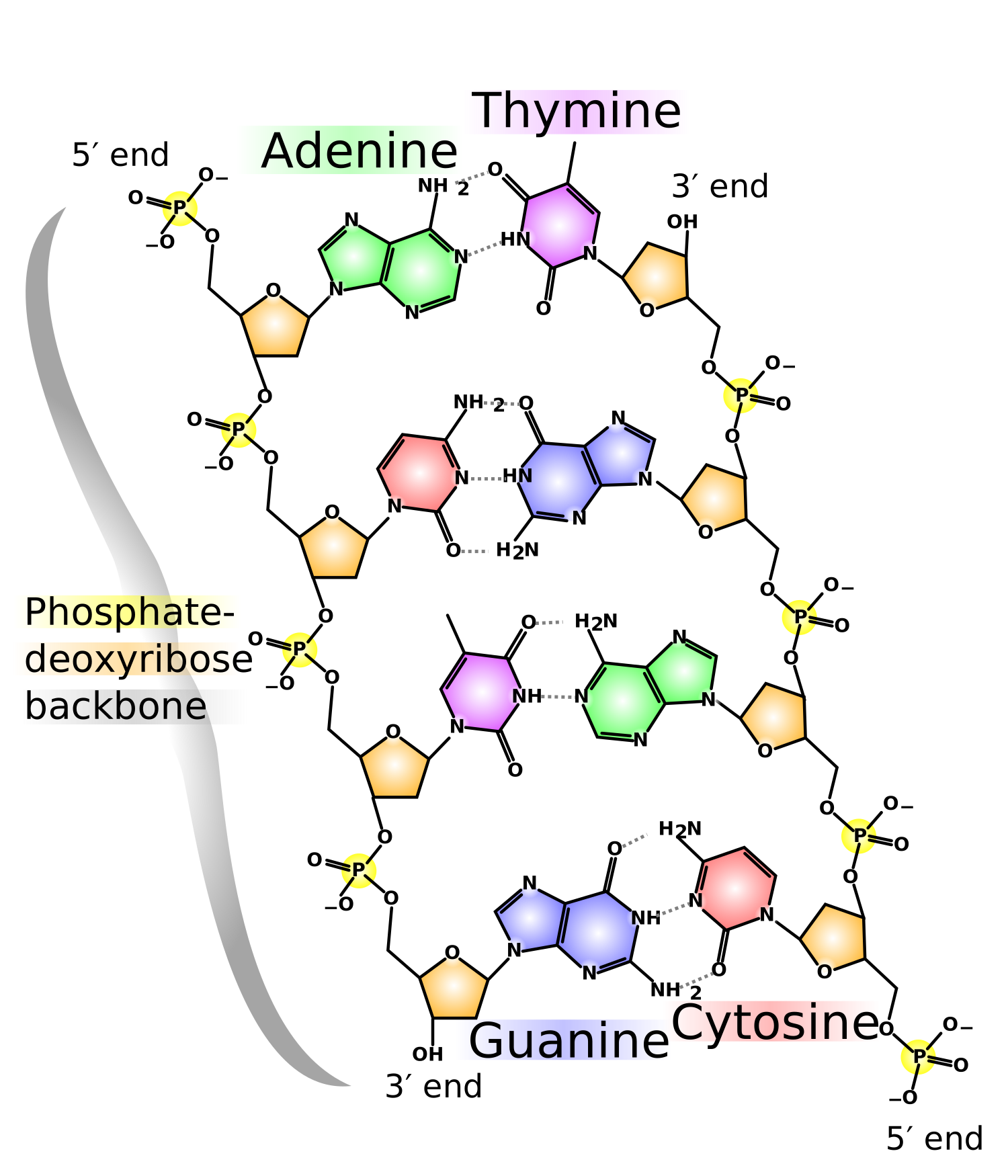 |
In last week's show David Deutsch took us from the metaphysics and physics of our previous shows toward chemistry, biology, cognitive human beings, and epistemology. In tonight's talk, James revisits some of the chemistry of the matter, and he recalls his personal involvement with one of the three most important ideas of the twentieth century (which were: Quantum Physics, Computation, and DNA). I particularly like the first paragraph from Watson and Crick's Molecular Structure of Nucleic Acid (Nature, 1953):
"We wish to suggest a structure for the salt of deoxyribose nucleic acid (D.N.A.). This structure has novel features which are of considerable biological interest."
Lastly, James goes on to take a look at how all that effects how different people relate to reality in different ways. People need to understand that it's not just what we think differently, that is to say: what we disagree on; it's also how we think differently, such as spatio- temporally, logico- mathematically, musico- kinesthetically, socio- linguistically, &c. You can come up with a good set of these sorts of differences: it is interesting to compare and contrast them with personality types. And the neat thing is that it doesn't matter why humans are this way, that is to say: whether God made it so or it just is so; what matters about it per se is that it is so.
2009-02-08
Good evening ladies and gentlemen. Tonight, for your delectation and pursuant to our Saturday night distinguished lecture, documentary & interview series, here is Jeff Hawkins, founder of the Redwood Center for Theoretical Neuroscience, presenting his talk: Brain Science is about to Fundamentally Change (2003, 22:10).
I think it can be reasonably argued that our DLDI series has, at least so far, some dependence on the processing engine involved thereto, even though I don't think that effects the fundamental undergirding; yet so it is that if we are to look at knowledge, then we must consider our implementation of knowledge. Epistemology, like metaphysics, doesn't depend, in my opinion, on the human engine, but we do.
In this video Jeff takes a look at some of the ways in which our understanding of our processing engine is changing, most notably that intelligence might not be principally about logic and reason per se, rather, it might be more about memory and the predictive accuracy of our pattern matching skills (of which logic and reason are two particularly effective examples).
2009-02-15
Good evening ladies and gentlemen. Tonight, for your delectation and pursuant to our Saturday night distinguished lecture, documentary & interview series, here is Daniel Dennett, Austin Fletcher Professor of Philosophy and co-director of the Center for Cognitive Studies at Tufts University, presenting his talk: Can We Know Our Own Minds? (23:45).
Last week, Jeff Hawkins stood on the shoulders of our previous physics and genetics shows and started taking a look at our neo-cortex and how the modern human brain works. Now hold on to your seats: in tonight's talk, Dan notes that not only don't we understand our own consciousness, but that half the time our brains are actively fooling us. As Dan says: "Your consciousness is not quite as marvelous as you may have thought it is [...] consciousness is a bag of tricks". Of course, tonight's show wouldn't be complete if I didn't at least slightly disagree with Dan, in the sense that I think said bag of tricks is, indeed, marvelous.
2009-02-22
Good evening ladies and gentlemen. Tonight, for your delectation and pursuant to our Saturday night distinguished lecture, documentary & interview series, here is Dan Gilbert, professor of psychology at Harvard, presenting his talk: Why are we happy? Why aren't we happy? (2004, 22:02).
In our previous distinguished lecture series shows, we worked our way from metaphysics to epistemology to Hawkins' discussion of our neocortex, and Dennett's discussion of our consciousness. Tonight, Gilbert takes a look at our prefrontal cortex, our synthesis of happiness, and our psychological immune system.
2009-03-01
Good evening ladies and gentlemen. Tonight, for your delectation and pursuant to our Saturday night distinguished lecture, documentary & interview series, here is Matthieu Ricard, previously a molecular geneticist as the Pasteur Institute, and now a Buddhist monk, presenting his talk: Habits of Happiness (2004, 20:55).
Last week, Dan Gilbert rounded out our very hasty walk, over the last two months, from the cosmos to atoms to the value of predictive pattern matching, consciousness, and happiness. In tonight's show Mattieu continues our look into what new science and technology are telling us about ourselves, and how that relates to ancient versions of said understanding, once at a mystical level, now moving toward an epistemological level. Mattieu's combination of Buddhist monk plus scientist I find interesting, much as in the way I find Lee Kwan Yew's combination of Oxford economist and Confucian interesting.
2009-03-08
Good evening ladies and gentlemen, welcome to our regular Saturday night Distinguished Lecture, Documentary, and Interview series. Tonight, for your delectation, here is Mr. Benjamin Zander presenting his talk: Classical Music with Shining Eyes (20:43).
2009-03-15
Good evening ladies and gentlemen. Tonight, pursuant to our distinguished lecture, documentary & interview symposia, on Friday night this week because I feel like it, here for your delectation is Steven Henry Strogatz, the Jacob Gould Schurman Professor of Applied Mathematics at Cornell University, presenting his talk on How Things in Nature Tend to Sync Up (23:13). Steven is known for his contributions to the study of synchronization in dynamical systems, and for his work in mathematical biology, engineering, and complex network theory, including his Nonlinear Dynamics and Chaos textbook.
In tonight's show, Steven asks, demonstrates, and answers the question: "Does existence need life to achieve synchronization?". And of course the answer is no, yet the mechanism you may find to be more fascinating than you would have thought it to be had you not watched this symposium, not having realized that when the metronomes are placed on the coupled rollers, they then have and do utilize that mechanism for the exchange of information. Without life. Like stars and leptons. Which reminds me of the first two shows in this series (what, you didn't expect me to link it back up?).
One of my favourite quotes from Steven in this video starts at 5:49:
Keep in mind that although it looks as if each individual is acting to cooperate, what's really going on is a kind of selfish Darwinian behaviour; each is scattering away at random, to try to save its [self]. That is, out of the desire to save itself, each creature is following these [four simple] rules, and that leads to something that's safe for all of them.Even though it looks like they're thinking as a group: they're not.
That's so cool. Has it ever occurred to you that it may be the case that the only thing that fundamentally exists, metaphysically, is information, and that things like matter, energy, and force are just categorizations that we apply to manifestations of certain classes of metaphysical information, which we use as epistemological tools? It may be all well and good that a planet has to orbit a star according to Kepler's laws, but how does that planet know that star is there? The answer, of course, may be that gravity is nothing more than a kind of information.
2009-03-22
Good evening ladies and gentlemen. Tonight, for your delectation and pursuant to our Saturday night distinguished lecture, documentary & interview series, here are Jerry Seinfeld and Steve Martin in their interviews with Charlie Rose (2007, 56:02).
2009-03-29
 |
 |
 |
 |
2009-04-05
Good evening ladies and gentlemen. Tonight, for your delectation and pursuant to our distinguished lecture, documentary & interview series, here is biophysicist Luca Turin presenting his talk on The Science of Scent (15:53).
2009-04-12
Good evening ladies and gentlemen. Tonight, for your delectation and pursuant to our distinguished lecture, documentary & interview series, here is molecular biologist Dr. Bonnie Bassler presenting her talk on The Secret, Social Lives of Bacteria (2009, 18:59). What, you didn't know how much of humans are actually bacteria that talk to each other, already?
2009-04-19
Good evening ladies and gentlemen. Tonight, for your delectation and pursuant to our distinguished lecture, documentary & interview series, here is behavioural economist Dan Ariely presenting his talk, Why We Think It's OK to Cheat & Steal (Sometimes) (2009, 18:24).
TED says that "Dan studies the bugs in our moral code: the hidden reasons we sometimes think it's ok to cheat or steal. Clever studies help make his point that we're predictably irrational -- and can be influenced in ways we can't grasp."
That's ok so far as it goes, I s'pose, but, pace TED, I'd say that Dan: explores the ways in which we titrate the measure of our sense of what counts as cheating, and I think you may find that the results he finds are more interesting than you may think you would have thought, especially considering the parts where he talks about how all this influences market bubbles and government misbehaviour.
Lastly, I would suggest, for those interested, the Published Works section of Dan's Wikipedia page; one of my favourites is: Try it, you'll like it: The influence of expectation, consumption, and revelation on preferences for beer (PDF).
2009-05-03
Good evening ladies and gentlemen. Tonight, for your delectation and pursuant to our Saturday night distinguished lecture, documentary & interview series, here is Nobel laureate Dr. Kary Mullis, chemistry professor and co-discoverer of the Polymerase Chain Reaction, presenting his talk: Celebrating the Scientific Experiment (31:33).
There are, in terms of available historic data, a large number of readers who understand and appreciate natural curiosity and skepticism; science, experimentation, and empiricism; and the dangers presented by scientific bureausclerosis, and worse, ideological charlatanism, such as that proselytized by enviro-wieners like the climate change apocalyptists (for example). Fortunately, Dr. Mullis covers all that, and the matter of frogs' natural desire for space flight, thus it is that I think that it may be the case that a non-trivial fraction of readers might appreciate Kary's talk.
2009-05-10
 |
2009-05-17
 |
2009-05-24
 |
Good evening ladies and gentlemen. Tonight, for your delectation and pursuant to our Saturday night distinguished lecture, documentary & interview series, here is Dr. Walter Lewin, professor of physics at the Massachusetts Institute of Technology. He is well known for his M.I.T. OpenCourseWare lectures for their first and second physics courses: 8.01 ~ Classical Mechanics and 8.02 ~ Electricity and Magnetism. Prof. Lewin is also well known for his shtick, his love of his subject matter, and his devotion to his students' quest for knowledge. Before digging further into 8.01 and 8.02, you might like to check out this interview with Walter Needless to say, I've watched all 72 lectures, totaling about sixty hours (partly because I like them better than many other so-called forms of entertainment, partly for old-times' sake, and partly because they apply every day to every-day life), and while it's difficult to pick favourites, I will say that one of my favourite lectures is 8.01-28: Hydrostatics, Archimedes' Principle, & Bernoulli's Equation, in the Goldilocks sense: it's not too hot, it's not too cold: it's just right (sort of like my lecture on the 30'th anniversary of the Peng-Robinson Equation of State). Anyway, without further ado, here are the lectures: 2009-05-31 Good evening ladies and gentlemen. Tonight, for your delectation and pursuant to our Saturday night distinguished lecture, documentary & interview series, here are excerpts from the inimitable Mr. Jackie Mason's Lecture & II from the occasion of his being awarded a fellowship in the Oxford Union Society in 1992. 2009-06-14 Good evening ladies and gentlemen. Tonight, for your delectation and pursuant to our distinguished lecture, documentary & interview series, here is Dan Ariely, professor of behavioural economics, head of the eRationality research group at the MIT Media Lab, and author of Predictably Irrational (an excellent book, I think), presenting his talk, Are we in control of our decisions? (17:26). 2009-06-20 2009-06-27 The key thing keep in mind here is that the assumptions upon which classical thermodynamics is based (macroscopic-scale closed systems) mean that classical thermodynamics cannot be used to draw conclusions about the microscopic-scale behaviour of the molecular machines involved in the phenomenon known as life, and that, therefore, it is not necessarily the case that life is subject to the second law of thermodynamics or equivalent. Please note that the debate here is not about whether or not god created and/or controls thermodynamics and/or life, the debate here is about the relationship between thermodynamics, the microscopic machines that implement life, and the question of information as the fundamental metaphysical reality. To begin with this afternoon, we have a new paper in Physical Review Letters, 102, 210601 (2009), by Raoul Dillenschneider and Eric Lutz, entitled Memory Erasure in Small Systems. Dillenschneider and Lutz have found that Maxwell’s demon (which can sometimes decrease the entropy of a system without performing work) could exist in nanoscale systems, even though it would not violate any macroscopic-scale physical law: Next up, here's a video by Drew Berry, of the Walter & Eliza Hall Institute of Medical Research, entitled Molecular Visualizations of DNA (7:47). It shows animations of DNA coiling and replication, RNA transcription, and its translation into proteins. Keep in mind that the molecular-scale machines shown in these visualizations are operating at millions of trillions of times per second in (and on) your body, and likewise in all other forms of life here and elsewhere. They are not (at this scale) subject to classical thermodynamics, which as Van Wylen and Sonntag noted: "disregards the actions of individual molecules". And note in particular that it is errors in the operation of this uncountably large number of molecular machines which lead over a very long time scale to the mutation events and natural selection forces commonly known as evolution, which some have thought was denied by classical thermodynamics. Lastly, this afternoon, we bring together all the above results to show some examples of how they effect life itself. Here, for your delectation, is Dr. Lucy Shapiro, Ludwig Professor of Cancer Research at Stanford University, presenting her Charles M. & Martha Hitchcock Lecture: The Systems Architecture of a Bacterial Cell Cycle (2009, 1 hour). In this lecture, Dr. Shapiro "examines the functions required to reproduce and maintain life in the simple bacterial cell by using a systems engineering approach that defines the control circuitry integrated in time and space". Her lab has found that the mechanisms described in the lecture are not subject to gross thermodynamic control. She notes that "In fact what I've shown you is that there is a forward biased circuitry that drives cell cycle progression, and the progression through the cell cycle is paced in a ratchet-like fashion, so that you have gates moving forward and opening allowing you to go from one state to another". And lastly, Dr. Shapiro notes in response to an audience question, "Is it going to be a logical progression? Sure. It's not stochastic events [...]." 2009-07-04 Good afternoon ladies and gentlemen, welcome to this week's symposium. Today, for your delectation, here is Dr. Gregory Chaitin, from IBM's Thomas J. Watson Research Center, giving his Alan Turing Lecture on Computing and Philosophy, Epistemology as Information Theory: from Libnetz to the Omega Number, II, III, IV, V, VI, & VII, at Mälardalen University, Västerås, Sweden, in 2005. If you find that interesting, and would like a little more information, here is Professor Chaitin's Carnegie Mellon University School of Computer Science Distinguished Lecture in 2000: A Century of Controversy Over the Foundations of Mathematics, II, III, IV, V, VI, VII, & VIII. 2009-07-11 Good afternoon ladies and gentlemen, welcome to this week's symposium. Today, for your delectation, here is The Amazing Randi visiting Australia in order to conduct some scientific experiments regarding the veracity of the alleged phenomenon known as Dowsing (1980, 43:53). 2009-07-31 Good afternoon ladies and gentlemen, welcome to this week's symposium. This week, for your delectation, here is Dr. Dan Gilbert, professor of psychology at Harvard University, presenting his Exploring the Frontiers of Happiness lecture, in 2005 (34:09). 2009-09-06 Good afternoon ladies and gentlemen, welcome to this week's symposium. This week, for your delectation, here from the Science Futures series by the San Diego Science and Technology Council's Center for Ethics in Science and Technology, and UCSD-TV, is Baroness Onora O'Neill, Principle of Newnham College at the University of Cambridge, presenting her Why Doesn't the Public Trust Scientists? ¤ lecture, in 2005 (58:32). I should like to note that while "Scientists" are the exemplary referent matter in today's lecture, Baroness O'Neill's considerations (for example, that one can't replace trust with trustworthiness [quis custodiet ipsos custodes?], statutory regulation, post hoc accountability, &c) apply more broadly to the matter of the public trust of any and every public profession and institution, including politics and the law. 2009-09-26 For today's symposium, Dr. Merzenich explains how your brain is always actively going on rewiring itself, how that rewiring is subject to your attention, and thus how your allocation of your attention resources is relevant to the future of your brain, to how you nurture your brain, and to your happiness, your wellbeing, your abilities, and your capacities; and how you are responsible for that. 2009-10-03 Good afternoon ladies and gentlemen, welcome to this week's symposium. This week, for your delectation, here is Michael Shermer, director of the Skeptics Society, presenting his TED Talk on Why People Believe Strange Things ¤ (14:11), in which he argues that in the absence of sound science, incomplete information can combine with the power of suggestion to produce false results. In fact, Michael says, we humans tend to convince ourselves to believe: we overvalue the "hits" that support our beliefs, and discount the more numerous "misses". And please note, before anyone flies off the handle, Michael does not believe that science can invalidate religion. He says so. Rather, his central issue in today's lecture, and the central topic in our symposium here today, is: confirmation bias. Lastly, before anyone thinks that I am claiming that I don't suffer from confirmation bias, to be clear: it's one of the things I'm most worried about doing (to the degree that I worry about anything at all). 2009-10-31 Good afternoon ladies and gentlemen, welcome to this week's symposium. This week, for your delectation, here is our old friend David Elieser Deutsch, FRS, Visiting Professor in the Department of Atomic and Laser Physics at the Center for Quantum Computation, Clarendon Laboratory, University of Oxford, who we first visited here in our 2009-01-25 DLDI show, today presenting his recent TED talk, A New Way to Explain Explanation ¤ (17:15), in which he argues, and quite well I think: 2009-11-29 Richard touches on many aspects of science and discovery that I think are important for us to occasionally revisit, especially during trying times like this when there is the danger from some that the immeasurable good that we have obtained via science over the millennia is threatened by those who would trash science per se solely for their own personal gain or simply out of anger that some people fraudulently claimed to be doing science when they were not. 2010-01-01 Good afternoon ladies and gentlemen, welcome to this week's symposium. This week, for your delectation, here is Israeli conductor Itay Talgam presenting his TED talk Lead Like the Great Conductors ¤ (23:24). Personally, I think that there are probably lessons for each and every one of us, and for all of us, in Maestro Talgam's talk. 2010-04-17 2010-05-01 Good afternoon ladies and gentlemen, welcome to this week's symposium. This afternoon, for your delectation, here is Daniel Kahneman, professor emeritus of psychology & public affairs at Princeton University's Woodrow Wilson School, and 2002 Nobel Laureate in Economics, presenting his Charles & Martha Hitchcock Explorations of the Mind lecture, Intuition: The Marvels and The Flaws ¤ in 2007 (56:00). 2010-06-12 There are also some additional excellent excerpts at their gems page, and 2010-07-01 Good afternoon ladies and gentlemen, welcome to this week's symposium. This afternoon, for your Dominion of Canada Day weekend, and all-round general- purpose entertainment, here is The DJ Vitruvius TV Theme Songs Quiz parlour game. This quiz consists of a pair of YouTube videos that contain clips of about twenty seconds duration each from forty television show theme songs from the fifties through the eighties. The total duration of this quiz is sixteen minutes. A quiz form, the quiz, and the answer key (with related links) are available at the above link. This quiz is for entertainment purposes only: please, no gambling ;-) 2010-08-15 The Goon Show was a seminal British radio comedy programme, originally produced and broadcast by the BBC Home Service from 1951 to 1960, starring Spike Milligan (KBE), Harry Secombe (CBE), and Peter Sellers (OBE), originally including Michael Bentine (CBE), and commonly featuring Max Geldray on harmonica, and Ray Ellington and his quartet. Below are 126 of the episodes of The Goon Show that are now available via YouTube. These are audio tracks (since it was a radio show), but we do have the very good fortune of also having available a rare video transcription of "The Goons" performing The Whistling Spy Enigma live. I most highly recommend viewing that video first: for Goon beginners it will establish the situational understanding for the remaining shows, and for Goon old-timers [ my Tornado (KC-166) was named the "Seagoon" when I skippered 'er! ] it is (I must say) a treat in and of itself. After that and without further ado, here are The Goon Show episodes. 2010-08-21 2010-09-03 2010-11-28 Good evening ladies and gentlemen, welcome to this week's distinguished lecture, documentary & interview symposium. This week, for your delectation, we have Dr. Eric Kandel, winner of the 2000 Nobel Prize in Medicine for his research on the physiological basis of memory storage in neurons, and Dr. Thomas Jessell, who for the past two decades has worked to understand how nerve cells in the developing spinal cord assemble into functional circuits that control sensory perception and motor actions, presenting the four talks of the 2008 Holiday Lectures on Science series, from the Howard Hughes Medical Institute, which was entitled: Making your Mind ~ Molecules, Motion, and Memory. 2010-12-02 2011-06-08 Good evening ladies and gentlemen, welcome to this week's distinguished lecture, documentary and interview symposium. This week, for your delectation, here is Tom Malzbender presenting his Google Tech Talk entitled Imaging the Antikythera Mechanism. Tom is a senior researcher at Hewlett-Packard Laboratories; this talk is about the Polynomial Texture Mapping algorithm he has developed, and about its applications to computer graphics, archeology, geology, forensics, the Antikythera Mechanism, &c. PTM Allows one to see dramatically more of an object's surface texture detail, from a set of photographs (taken under changing light source location), than one can see from said photographs with the naked eye alone. Its applications range from the microscopic to the macroscopic, it's a technique you can use at home, the software is freely available, and the mathematics isn't even very difficult. PTM algorithms can also be used to determine surface texture renderings from elevation maps. One can even use PTM to do smooth focus variation between a half-dozen images taken, in a fraction of a second, from a single position and with a single lighting situation, but across a range of focal lengths (if one has enough light plus film speed), a technology which one can imagine integrated into future digital cameras. 2011-06-16 In honour of the legacy of accomplishments achieved by IBM, and of their ongoing work to this day, we have here today for our Distinguished Symposium a pair of films highlighting, I think, some of the best kinds of results one can get from these sorts of institutions. We also have, I think, some very classy marketing. Without further ado, here are: Happy 100'th birthday, IBM: A job well done. 2011-10-22 2012-01-15 Here are four performances by Kodo (鼓童), who are based on Sado Island in Japan, and whom I saw performing at the Jubilee Auditorium in Edmonton, fifteen or twenty years ago. Lastly, here's a tour-de-force performance by the San Francisco Taiko Dojo, featuring Seiichi Tanaka, Kenny Endo, and Jimmy Nakagawa · M.I.T. Physics 8.01
Classical Mechanics · M.I.T. Physics 8.02
Electricity & Magnetism·
Good afternoon ladies and gentlemen. This afternoon, for your delectation and pursuant to our distinguished lecture, documentary & interview series, here, at the Institute for Neural Computation and in the Frontiers of Knowledge lecture series from the University of California at San Diego, is Dr. Stephen Wolfram presenting his talk A New Kind of Science (1:26:42), for the 2003 H. Paul Rockwood memorial lecture. In this afternoon's talk, the controversial Dr. Wolfram introduces the now famous Rule 30 and many of the other concepts that lead some of us to think that, at scales a dozen orders of magnitude smaller than anything ever before contemplated, it may be the case that all that actually exists is information. I would suggest that one can easily see why Mr. Wolfram's ideas are at least interesting. 
Good afternoon ladies and gentlemen. As you know, there has been a bit of an ongoing debate regarding the applicability of classical thermodynamics and its entropy model to microscopic systems and to open systems, and regarding the information- theoretic nature of reality. This afternoon, for your delectation and pursuant to our distinguished lecture, documentary & interview series, we have a new paper by Dillenschneider and Lutz arguing that Maxwell's Demon can exist in nanoscale systems, a short video showing visualizations of the molecular-scale machines involved in replicating DNA, extracting RNA, and synthesizing proteins, and a longer video by Dr. Lucy Shapiro on The Systems Architecture of a Bacterial Cell Cycle.
Dr. Shapiro
“Our research aims at describing the thermodynamic behavior of tiny (nanoscale) objects,” Lutz told PhysOrg.com. “It is known that thermal fluctuations dominate at these length scales. However, our investigations showed that they can have observable consequences in nanomemories: information may be erased by dissipating less heat than required by Landauer's principle."
Good afternoon ladies and gentlemen, welcome to this week's symposium. This week, for your delectation, here is Dr. Michael Merzenich, neuroscientist and professor emeritus at UCSF, presenting his lecture On Rewiring the Brain (23:07).
That the truth consists of hard to vary assertions about reality
is the most important fact about the physical world.
Good afternoon ladies and gentlemen, welcome to this week's symposium. This week, for your delectation, here is the great Dr. Richard Phillips Feynman presenting his excellent thoughts on The Pleasure of Finding Things Out, II, III, IV, and V, from his interview on the Horizon television programme in 1981.
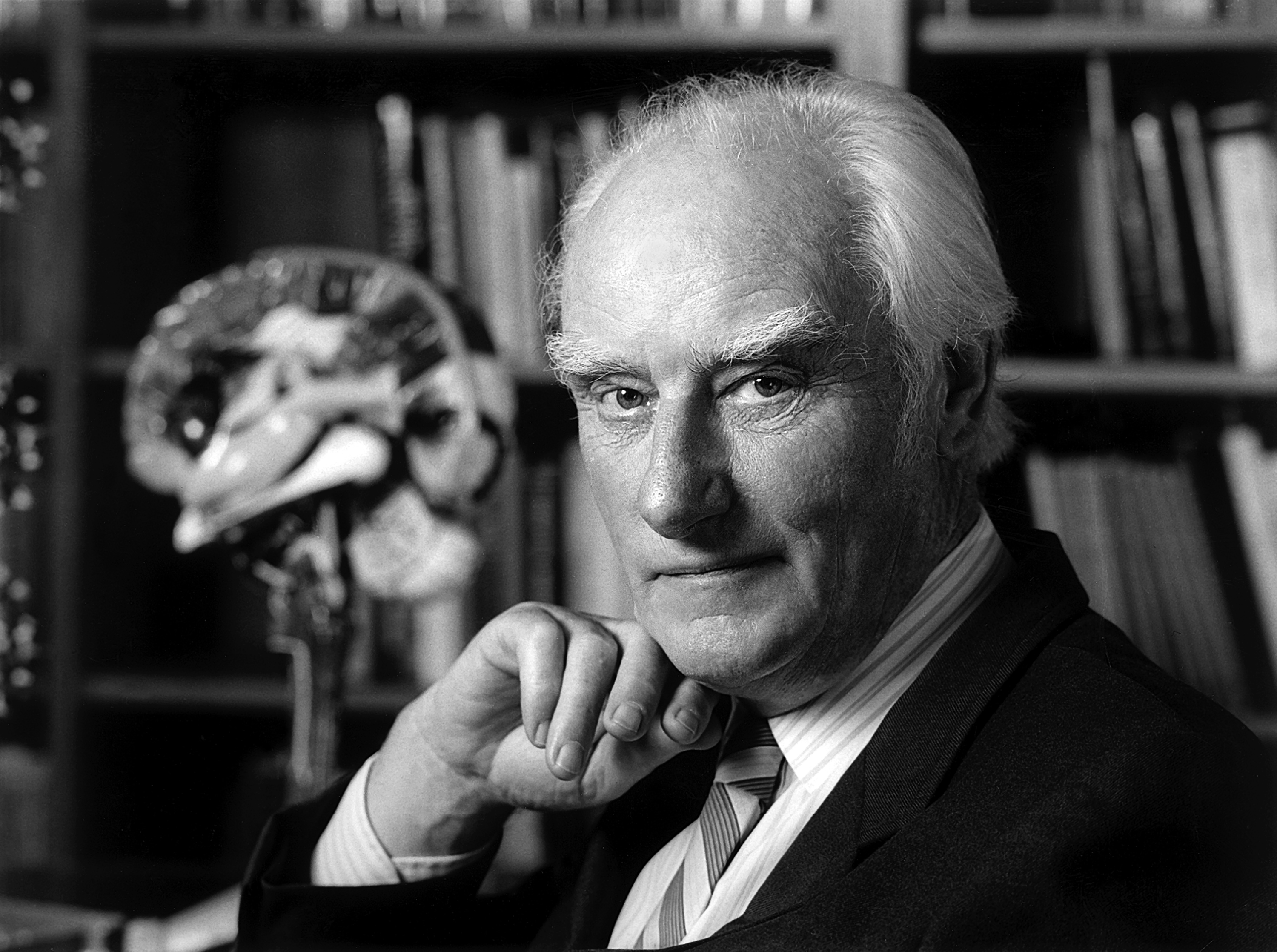
Good afternoon ladies and gentlemen, welcome to this week's symposium. This afternoon, for your delectation and to restart our series, here from the University of California at San Diego's GuestBook productions is Francis Harry Compton Crick, OM, FRS & 1962 Nobel Laureate in Medicine, in conversation with Nick Spitzer, Professor of Biology at UCSD, on the matter of Investigations of Human Consciousness ¤, in 1999 (26:10). Dr. Crick was, at the time of this conversation, the J. W. Kieckhefer Distinguished Research Professor at the Salk Institute for Biological Studies. Today's conversation re-establishes a number of the topics we intend to continue exploring in future symposia.
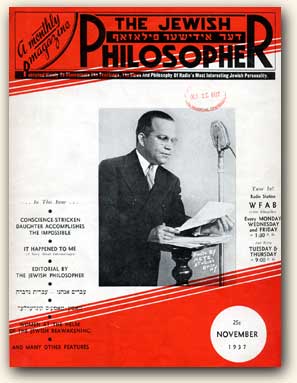
Good afternoon ladies and gentlemen, welcome to this week's distinguished
lecture, documentary & interview symposium. This afternoon, for your
delectation, here are the collected works of the Yiddish Radio Project,
and in particular their Exhibits radio shows, from the '20s through the '50s. 


Exhibits Audio Show More Time The History of Yiddish Radio § 16:45 Yiddish Melodies in Swing § 16:00 Radio Dramas of Nahum Stutchkoff § 22:17 The Jewish Philosopher ¶ § 11:15 Commercials on Yiddish Radio § 12:14 Levine & his Flying Machine § 12:29 Seymour Rexite § 6:14 Victor Packer § 12:35 Rabbi Rubin's Peace & Justice § 11:16
note that you need a RealPlayer client to listen to these old radio shows.
Good afternoon ladies and gentlemen, welcome to this week's distinguished lecture, documentary & interview symposium. James Burke is a British broadcaster, science historian, author, and television producer known for his Connections and The Day the Universe Changed documentary television series, which focused on the history of science & technology, leavened with a sense of humour. The various series traced paths of invention & discovery through their interrelationships in history, and explored the philosophical aspects of scientific change on Western culture. This week, for your delectation, here are links to those shows now available at YouTube.
Good afternoon ladies and gentlemen, welcome to this week's symposium. This week, for your delectation, we have the Alaska Highway (35:21), a restricted distribution film produced by the War Department of the United States of America, in 1944, about the development of the land route from Edmonton to Dawson Creek, Whitehorse, and Fairbanks. The Alaska (ALCAN) Highway was originally built by ca. 25,000 troops, it was officially completed on October 13, 1943, and it has been continually upgraded since then. I've occasionally been asked, "Vitruvius, what great adventure would you like to explore next?" Personally, I'm currently thinking about driving the route shown on this map.
Lecturer Lecture Title Kandel Mapping Memory in the Brain Jessell Building Brains ~ The Molecular Logic of Neural Circuits Jessell Plan of Action ~ How the Spinal Cord Controls Movement Kandel Memories are Made of This
Good evening ladies and gentlemen, welcome to this week's distinguished lecture, documentary & interview symposium. In 2003 the British ITV ran a series known as The Adventure of English, based on a companion book written by the Right Honourable Lord Melvyn Bragg, Baron of Wigton in the County of Cumbria, FRSL, FRTS, FRS, FBA. This week, for your delectation, we have the eight fifty-minute episodes of The Adventure of English, narrated by Lord Bragg.

On June 16, 1911, the Computing Tabulating Recording Corporation was founded, through the merger of the Tabulating Machine Company, the International Time Recording Company, the Computing Scale Corporation, and the Bundy Manufacturing Company. In 1924 they adopted the name International Business Machines, using the name previously designated to their subsidiary in Canada.
Good evening ladies and gentlemen, welcome to this week's distinguished lecture, documentary and interview symposium. This week, for your delectation, here is Tufts University Professor Daniel C. Dennett's lecture: Evolution, Culture, and Truth (57:30, his lecture itself starts at 07:00 into the video). Old-hand Distinguished Symposia participants may recall our previous visit with Professor Dennett, on 2009-02-15, when he gave his Can We Know Our Own Minds? TED Talk.
Good evening ladies and gentlemen, welcome to this week's distinguished lecture, documentary and interview symposium. This week, for your delectation, we feature kumi-daiko (組太鼓), the relatively recent art-form of ensemble Japanese taiko (太鼓) drumming, which may have originated with jazz drummer Daihachi Oguchi (小口 大八), ca. 1951.





<< Home